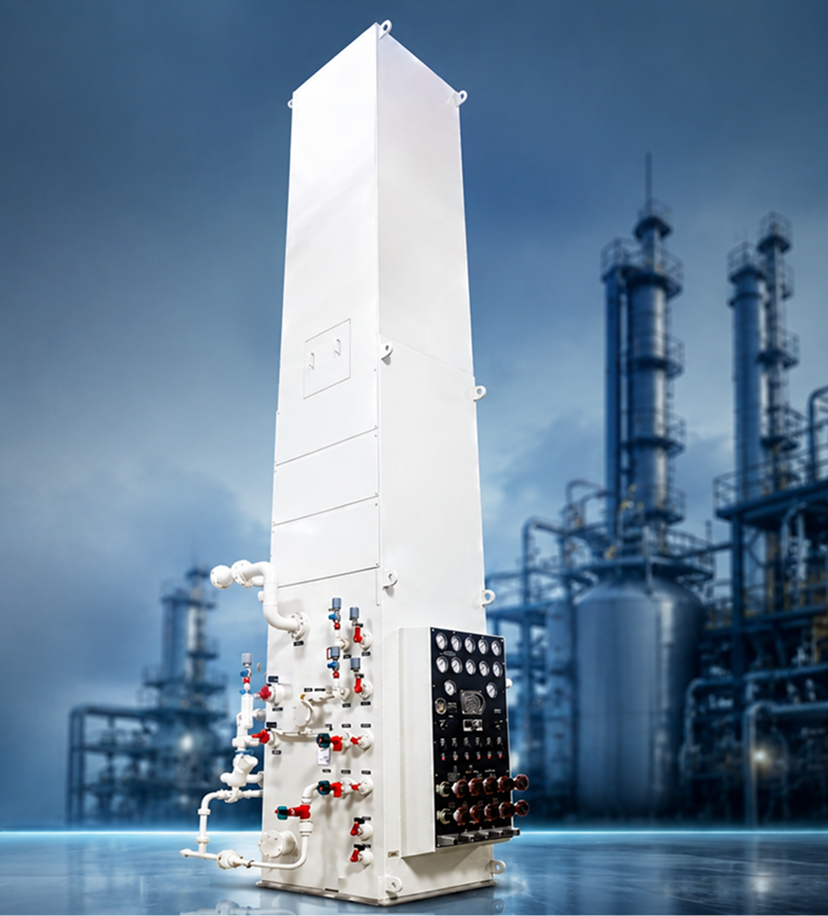
Oxygen / Nitrogen Gas Plant

Complete Features & Benefits of Our Plants

  • Our plant design incorporates special features that enable simultaneous production of high-quality Nitrogen gas along with Oxygen gas, resulting in greater economic viability without additional operating costs.
  • Equipped with a highly efficient expansion engine that provides rapid and adequate cooling, ensuring stable plant operation and consistent gas purity.
  • High standard of gas purity.
  • Low power consumption due to the low-pressure cycle plant design.
  • A special bypass valve is provided for quick production and improved cooling (R-4).
  • Fool-proof temperature indicating system with electronic scanner.
  • International-class pressure differential gauges serving as reliable liquid level indicators, integrated with a stainless steel control panel.
  • High-quality Perlite powder insulation to minimize cold loss.
  • Liquid Nitrogen withdrawal facility.
  • Separate Nitrogen pump.
Read More

Quotation For Oxygen/ Nitrogen Plant.

Click Here

Process Description

The atmospheric air mainly consists of oxygen and nitrogen gases and small quantities of water vapour, carbon dioxide and argon, helium etc. Oxygen and Nitrogen from air are separated due to difference in boiling points by distillation through a fractional column.

  Atmospheric air is sucked in by a multi stage compressor through a filter and compressed to the design pressure. The compressed air is then passed through intercoolers, Industrial refrigerator, moisture separators and then to the Molecular Sieve Battery for removal of Carbon dioxide, Hydro carbons and moisture from the process air. This pure air then passes through the first heat exchanger, where it is cooled by the out going Nitrogen and Oxygen. Part of this cooled air then passes through an Expansion Engine and the other part through the 2nd heat exchanger. Both the Expansion Engine and 2nd heat exchanger help in further cooling down the air, which is finally released to the bottom  of  the column  through an expansion valve. The air becomes liquid at this stage.

The column consists of two parts. Lower column and Upper column. In between the lower and upper column there is a condenser, which acts as a reflux for the lower column and as a re-boiler for the upper column. The liquid air at the bottom of lower column separates through the trays of the column to give crude oxygen at the bottom and approximately 90% pure Nitrogen at the top. Crude oxygen termed as rich liquid is then expanded through an expansion valve from the lower column to the middle of the upper column. Crude Nitrogen termed as poor liquid is expanded through another expansion valve from the top of the lower column to the top of the upper column. Due to difference in the boiling points, the pure Nitrogen boils over and accumulates at the top of the upper column and oxygen (which has a higher boiling point then Nitrogen) accumulates at the bottom of the upper column.

Both Nitrogen and Oxygen are removed through separate paths in heat exchangers, for cooling the incoming air. Oxygen is compressed to a prescribed settled pressure by a liquid pump and is directly filled into cylinders. Nitrogen is however available at a pressure of approximately 0.5kg /cm2 and the same can be compressed into cylinders with help of an independent high-pressure compressor.

  Normally the Nitrogen available is of 96 – 98% purity only and is let out in the atmosphere as waste product. However, when nitrogen is to be filled, into the cylinders for commercial use, the plant is controlled by change of the valve setting for making the mixed air chamber operative for achieving the required purity of Nitrogen (This is a specialty of our design)

Let's Connect

Industry Solutions Start with a Simple Contact